Greater celandine
Chelidonium majus
Plant Images
OneSeed Image
Description
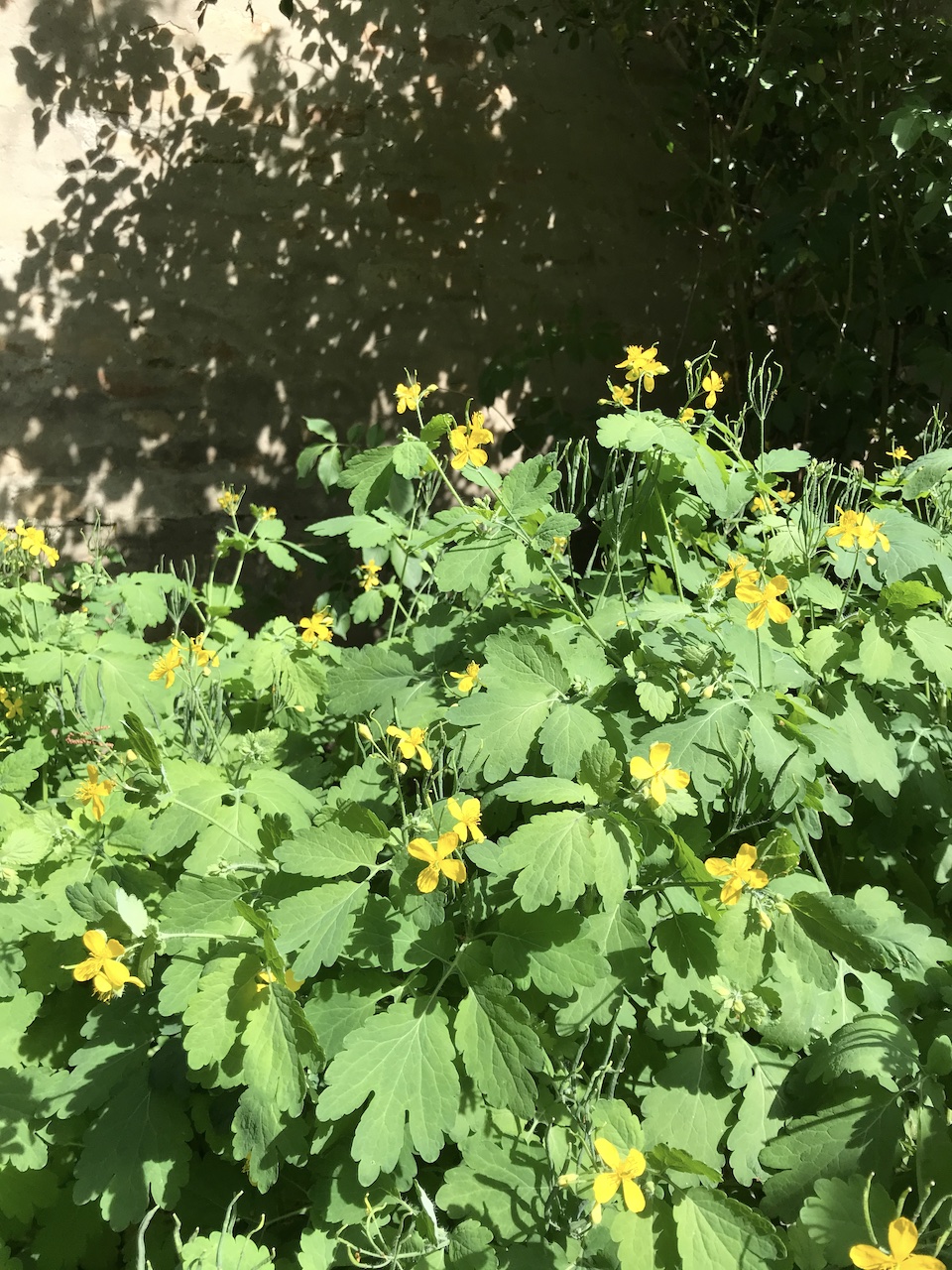
Greater celandine (Chelidonium majus) is a herbaceous perennial plant, with an underground rootstock, growing to 70 cm (28 in) tall. The leaves are 7–15 cm (3–6 in) long and 3–6 cm (1 1⁄4–2 1⁄2 in) broad, with a distinct narrow tapering at the base of the leaf blade, and a cordate or rounded, but not lobed, at the leaf base. The flowers are bright yellow, 4–6 cm (1 1⁄2–2 1⁄2 in) across, produced singly or in pairs from leaf axils near ground level; the petals are deeply notched. The fruit is a cluster of about 20 black seeds, each about 3 mm (1⁄8 in) diameter. The plant flowers from May to August.
Greater celandine is native to temperate regions of Europe and Asia, from Ireland and Great Britain east to the Caucasus, and north to central Scandinavia and southern Siberia. It is often found as a weed in gardens, and on waysides and waste ground. It prefers moist, shady locations. It is considered an invasive species in some areas, such as New Zealand and the Great Lakes region of North America.
The plant has a long history of use in traditional medicine. It was once used as a treatment for jaundice, and is still used in herbalism for this and other liver problems. The plant contains a range of biologically active compounds, but greater celandine is no longer recommended for medical use due to lack of evidence of efficacy and potential side effects.
Growing Details
Greater celandine is a herbaceous perennial plant, with an underground rootstock, growing to 70 cm (28 in) tall. The leaves are 7–15 cm (3–6 in) long and 3–6 cm (1 1⁄4–2 1⁄2 in) broad, with a distinct narrow tapering at the base of the leaf blade, and a cordate or rounded, but not lobed, at the leaf base. The flowers are bright yellow, 4–6 cm (1 1⁄2–2 1⁄2 in) across, produced singly or in pairs from leaf axils near ground level; the petals are deeply notched. The fruit is a cluster of about 20 black seeds, each about 3 mm (1⁄8 in) diameter. The plant flowers from May to August.
Greater celandine is native to temperate regions of Europe and Asia, from Ireland and Great Britain east to the Caucasus, and north to central Scandinavia and southern Siberia. It is often found as a weed in gardens, and on waysides and waste ground. It prefers moist, shady locations. It is considered an invasive species in some areas, such as New Zealand and the Great Lakes region of North America.
Tags
Attracts Wildlife
Scented Plant
Erosion Preventing
Bee Friendly
Invasive
Visual Appeal
Easy Propagating
Colouring
Range (Based on GBIF Data)
The map shows known occurrence points of <strong>Chelidonium majus</strong> recorded in scientific biodiversity databases.
Source: <a href="https://www.gbif.org" target="_blank">GBIF.org</a> — Global Biodiversity Information Facility
Location & Timing
native geo location: Europe, Western Asia
applicable geo region: Temperate zones
language used: english
Flowering:
beginning
of May for 120 days
Harvest:
middle
of May for 30 days
Seed Start:
beginning
of July
Indoor Start:
Transplant:
Uses & Benefits
Edible Rating:
(1/5)
edible uses: The plant is poisonous.
Medicinal Rating:
(3/5)
medicinal uses: Greater celandine has been used in traditional medicine for centuries, primarily as a treatment for liver problems such as jaundice. The plant is no longer recommended for medical use due to lack of evidence of efficacy and potential side effects.
health concerns: Greater celandine may cause contact dermatitis in some people. The plant contains alkaloids that can be toxic in large doses, and may cause vomiting and diarrhea. The plant may also interfere with the absorption of iron and other minerals.
other uses: None
Scientific Literature
Loading scientific articles about <strong>Chelidonium majus</strong>...
Botanical data
specie: Chelidonium majus
common names: rosopas, rusa
family: Papaveraceae
sub family: Fumaroideae
tribe: None
sub tribe: None
genus: Chelidonium
Growing Conditions
area needed: 0.4 m
spacing: 0.1 m
growing difficulty: Low
Deciduous / Evergreen: Deciduous
Seed Temp (Opt/Min/Max): 20°C / 5°C / 30°C
Plant Temp (Opt/Min/Max): 20°C / 5°C / 30°C
water demands: Medium
humidity:
light demands: Low
root type: Medium
frost tender: Low
hardness:
█
█
█
█
█
▁
▁
▁
▁
▁
(5/10)
first harvest: 2 years
life span: None years
succession:
growth rate: Fast
max height: 0.5 m
max width: 0.4 m
soil preference:
pH preference:
flower type:
Hermaphrodite
growth details: Greater celandine is a herbaceous perennial plant, with an underground rootstock, growing to 70 cm (28 in) tall. The leaves are 7–15 cm (3–6 in) long and 3–6 cm (1 1⁄4–2 1⁄2 in) broad, with a distinct narrow tapering at the base of the leaf blade, and a cordate or rounded, but not lobed, at the leaf base. The flowers are bright yellow, 4–6 cm (1 1⁄2–2 1⁄2 in) across, produced singly or in pairs from leaf axils near ground level; the petals are deeply notched. The fruit is a cluster of about 20 black seeds, each about 3 mm (1⁄8 in) diameter. The plant flowers from May to August.
Greater celandine is native to temperate regions of Europe and Asia, from Ireland and Great Britain east to the Caucasus, and north to central Scandinavia and southern Siberia. It is often found as a weed in gardens, and on waysides and waste ground. It prefers moist, shady locations. It is considered an invasive species in some areas, such as New Zealand and the Great Lakes region of North America.
Potential Disturbances: Greater celandine faces ecological pressures from aphids, caterpillars, slugs, and snails. Additionally, it may be challenged by a rust fungus.
Permanent Link
Scan this QR code for a permanent link to this plant:
 Download QR Code

Loading comments...