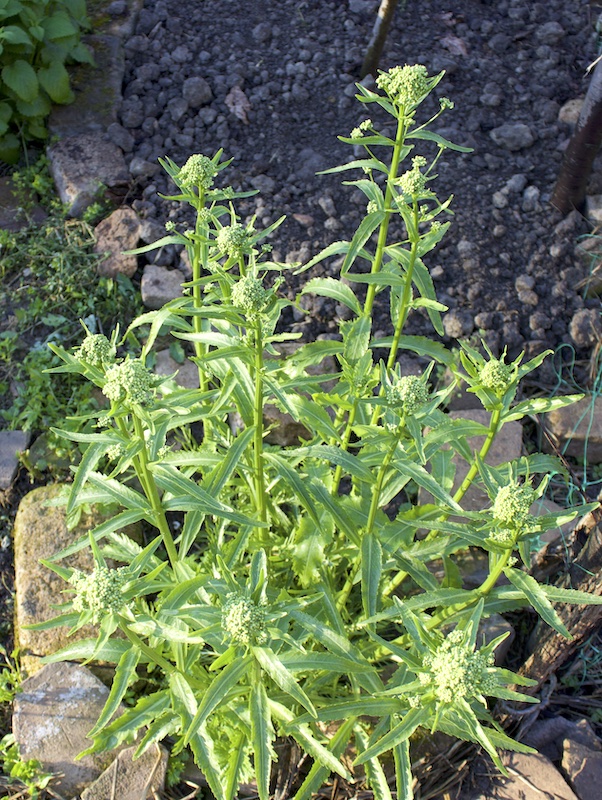
Horseradish is a perennial plant of the Brassicaceae family. The plant is probably native to southeastern Europe and western Asia. It is now popular around the world. It grows up to 1.5 m (4.9 ft) tall, and is cultivated primarily for its large, white, tapered root. The intact horseradish root has hardly any aroma. When cut or grated, however, enzymes from the now-broken plant cells break down sinigrin (a glucoside) to produce allyl isothiocyanate (mustard oil), which irritates the mucous membranes of the sinuses and eyes. Grated mash of horseradish is often used as a condiment or pickle. In the UK, grated horseradish is often mixed with vinegar and served with roast beef, but in the US it is more common to serve it undiluted or as an ingredient of a cocktail sauce. Horseradish sauce made from grated horseradish root and vinegar is a popular condiment in the UK. The sauce is sometimes called "creamed horseradish".
Growing Details
Horseradish is easy to grow and requires little space. It grows best in deep, moist, well-drained soils in full sun to partial shade. It is tolerant of a wide range of soils, including heavy clay soils. The root is the part of the plant that is used. It can be harvested at any time of the year, but is best in late autumn or early winter. Good companion for apples and potato.
Edible Parts
Leaves Seed Seed Pod
Tags
Attracts Wildlife Bee Friendly Easy Propagating
Range (Based on GBIF Data)
The map shows known occurrence points of <strong>Armoracia rusticana</strong> recorded in scientific biodiversity databases.
Source: <a href="https://www.gbif.org" target="_blank">GBIF.org</a> — Global Biodiversity Information Facility
Location & Timing
native geo location: Europe, W. Asia
applicable geo region: Temperate zones
language used: english
Flowering:
beginning
of May for 30 days
Harvest:
beginning
of October for 30 days
Seed Start:
?
Indoor Start:
Transplant:
Uses & Benefits
Edible Rating:
(3/5)
edible uses: The root and leaves can be used as a condiment.
Medicinal Rating:
(0/5)
medicinal uses: Horseradish is used as an ingredient in prepared mustards and as a spice. It has also been used as a folk medicine. The grated root of horseradish has been used as a rubefacient for temporary relief of minor muscle and joint pain. A poultice of grated horseradish has been used for temporary relief of chest pain due to inflammation of the lungs or other tissues. Inhaling steam from a decoction of horseradish has been used for temporary relief of nasal congestion. A tea made from horseradish has been used as a diuretic and for temporary relief of minor sore throat pain. A compress of horseradish has been used for temporary relief of headache pain. Julep of horseradish has been used for temporary relief of stomach pain and indigestion.
health concerns: Large quantities of this plant can be poisonous due to its content of volatile oils
other uses: None known.
Scientific Literature
Loading scientific articles about <strong>Armoracia rusticana</strong>...
Botanical data
specie: Armoracia rusticana
common names: Horseradish, ren
family: Brassicaceae
sub family: Brassiceae
tribe: Brassicae
sub tribe: Armoraciae
genus: Armoracia
Growing Conditions
area needed: 0.8 m
spacing: 0.3 m
growing difficulty: Low
Deciduous / Evergreen: Evergreen
Seed Temp (Opt/Min/Max): 0°C / 0°C / 0°C
Plant Temp (Opt/Min/Max): 0°C / 0°C / 0°C
water demands: Medium
humidity: Medium
light demands: Medium
root type:
frost tender:
hardness:█████▁▁▁▁▁(5/10)
first harvest: 1 years
life span: None years
succession:
growth rate:
max height: 0.7 m
max width: 0.8 m
soil preference:
pH preference:
flower type:
Hermaphrodite
growth details: Horseradish is easy to grow and requires little space. It grows best in deep, moist, well-drained soils in full sun to partial shade. It is tolerant of a wide range of soils, including heavy clay soils. The root is the part of the plant that is used. It can be harvested at any time of the year, but is best in late autumn or early winter. Good companion for apples and potato.
Potential Disturbances: Horseradish may encounter pressures from aphids, flea beetles, cabbage root fly, and cabbage whitefly, which can impact plant health.
Growth Timeline
Recipes Using This Plant
Animals Interacting With This Plant
Permanent Link
Scan this QR code for a permanent link to this plant:

Loading comments...