Black locust
Robinia pseudoacacia
Plant Images
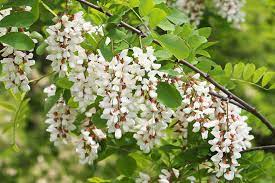
OneSeed Image
Description
Black Locust (Robinia pseudoacacia) is a fast-growing, nitrogen-fixing tree that can reach a height of 15 m in just a few years. It is a popular choice for living fence posts, as it is very tolerant of drought and poor soils. The wood is very strong and is often used for fence posts, firewood, and furniture. The flowers are very fragrant and attract bees, making this tree a good choice for a bee-friendly garden. Black Locust is considered an invasive species in many areas, so be sure to plan for maintenance before planting.
Growing Details
Black locust is a fast-growing tree that can reach a height of 30 m (100 ft) and a trunk diameter of 0.6 m. The tree has a short lifespan, typically 20–30 years. The bark is dark brown to black and is smooth when young, but it becomes deeply furrowed with age. The twigs are slender and hairless. The leaves are alternate, pinnately compound, 10–20 cm (4–8 in) long, with 7–19 oval, toothed leaflets. The flowers are white, 5–10 mm (0.2–0.4 in) long, borne in pendulous racemes 20–40 cm (8–16 in) long. The fruit is a dark brown, woody pod 10–20 cm (4–8 in) long, containing 2–6 seeds. Black locust is a legume, which means that it is able to fix nitrogen from the atmosphere into the soil. This makes it a good tree for restoring nitrogen to depleted soils. The black locust tree is also very tolerant of drought and salt. The tree can be a problem in pastures and forest because it is very aggressive and can crowd out other trees and plants. The tree produces a chemical that inhibits the growth of other plants, which gives it an advantage over other trees.
Edible Parts
Seed
Pollen
Nectar
Oil
Tags
Nitrogen Fixing
Hedge
Carbon Farming
Attracts Wildlife
Fire Wood
Building Wood
Scented Plant
Sacrificial Plant
Windbreak
Erosion Preventing
Bee Friendly
Invasive
Easy Propagating
Range (Based on GBIF Data)
The map shows known occurrence points of <strong>Robinia pseudoacacia</strong> recorded in scientific biodiversity databases.
Source: <a href="https://www.gbif.org" target="_blank">GBIF.org</a> — Global Biodiversity Information Facility
Location & Timing
native geo location: Eastern USA
applicable geo region: Worldwide
language used: english
Flowering:
middle
of May for 10 days
Harvest:
middle
of Jun for 30 days
Seed Start:
beginning
of November
Indoor Start:
Transplant:
Uses & Benefits
Edible Rating:
(3/5)
edible uses: Flowers are edible and seed pods can be boiled and used like peas
Medicinal Rating:
(2/5)
medicinal uses:
health concerns:
other uses: The wood of black locust is hard, strong, and durable. It is used for fence posts, furniture, charcoal, and firewood. The tree is also used as an ornamental tree and for erosion control. Black locust honey is dark and has a strong flavor. The flowers are also used to make a yellow dye. Black locust is a legume, which means that it is able to fix nitrogen from the atmosphere into the soil. This makes it a good tree for restoring nitrogen to depleted soils. The tree is also used for reclamation of coal mines and oil wells. Black locust is considered an invasive species in many areas, including parts of North America, Europe, Australia, and New Zealand. The black locust is a pioneer species, which means that it is one of the first trees to colonize an area after a disturbance. It is very tolerant of poor soils and can grow on sites that are too steep or rocky for other trees.
Scientific Literature
Loading scientific articles about <strong>Robinia pseudoacacia</strong>...
Botanical data
specie: Robinia pseudoacacia
common names: bagrem
family: Fabaceae
sub family: Faboideae
tribe: Robinieae
sub tribe: Robinieae
genus: Robinia
Growing Conditions
area needed: 10.0 m
spacing: 5.0 m
growing difficulty: Low
Deciduous / Evergreen: Evergreen
Seed Temp (Opt/Min/Max): 20°C / -40°C / 38°C
Plant Temp (Opt/Min/Max): 20°C / -40°C / 38°C
water demands: Medium
humidity:
light demands: High
root type: Medium
frost tender: Low
hardness:
█
█
█
█
█
▁
▁
▁
▁
▁
(5/10)
first harvest: 2 years
life span: None years
succession: Pioneer
growth rate: Fast
max height: 15.0 m
max width: 10.0 m
soil preference:
pH preference:
flower type:
growth details: Black locust is a fast-growing tree that can reach a height of 30 m (100 ft) and a trunk diameter of 0.6 m. The tree has a short lifespan, typically 20–30 years. The bark is dark brown to black and is smooth when young, but it becomes deeply furrowed with age. The twigs are slender and hairless. The leaves are alternate, pinnately compound, 10–20 cm (4–8 in) long, with 7–19 oval, toothed leaflets. The flowers are white, 5–10 mm (0.2–0.4 in) long, borne in pendulous racemes 20–40 cm (8–16 in) long. The fruit is a dark brown, woody pod 10–20 cm (4–8 in) long, containing 2–6 seeds. Black locust is a legume, which means that it is able to fix nitrogen from the atmosphere into the soil. This makes it a good tree for restoring nitrogen to depleted soils. The black locust tree is also very tolerant of drought and salt. The tree can be a problem in pastures and forest because it is very aggressive and can crowd out other trees and plants. The tree produces a chemical that inhibits the growth of other plants, which gives it an advantage over other trees.
Potential Disturbances: Black locust can be challenged by the black locust borer, sawfly, weevil, and Japanese beetle, affecting its growth and wood quality.
Permanent Link
Scan this QR code for a permanent link to this plant:
 Download QR Code

Loading comments...